
The base station stays the same.
The physical path changes.
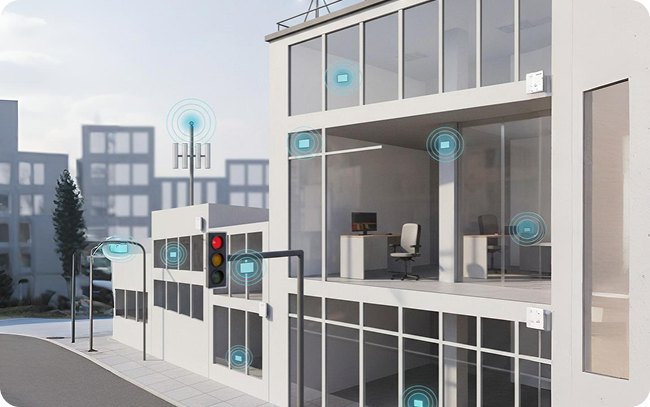
mmWave signals don't bend around obstacles — they stop. V-Mesh forms a coordinated multi-hop propagation path across network-controlled repeaters, continuously managed by the Visban AI Orchestrator as devices move and conditions change.
Built on glass, built to scale. See why
RF-on-Glass is a game changer.

How It Works
mmWave coverage depends on
a continuous line of sight.
The physics are simple: mmWave signals don't bend. Corners, building facades, foliage, and even glass interrupt propagation long before a device reaches its range limit.
Density shouldn’t be a debt. Networks typically try to "power through" by adding expensive base stations or offloading users to slower, congested lower-frequency bands.
We don’t just add hardware; we add intelligence. Visban repeaters function as a coordinated, network-managed system — dynamically orchestrated nodes that adapt the signal path in real-time as the environment changes.

The route changes while the
connection persists.
As devices move and surroundings change, the propagation path adapts in real-time. The Visban AI Orchestrator continuously identifies and shifts the signal across the network of repeaters so the mmWave connection remains uninterrupted — even during handovers.

The network
operates normally.
V-Mesh is designed to sit within your existing 5G/6G architecture — no rearchitecting or specialized device logic required. Devices connect and hand over between base stations exactly as they normally would, while V-Mesh maintains the underlying propagation path as a transparent network layer.

The intelligence
is predictive, not reactive.
The network doesn't just wait for a signal to drop; it stays ahead of the environment. The AI Orchestrator analyzes device movement and environmental data to proactively optimize the signal path. This ensures the highest-capacity link is always ready before an obstacle can interrupt the user experience.
Continuous outdoor-to-indoor mmWave coverage.
mmWave coverage doesn't stop at the window. V-Mesh extends the signal path into interior spaces, maintaining throughput as users move indoors — no fallback, no coverage gap.
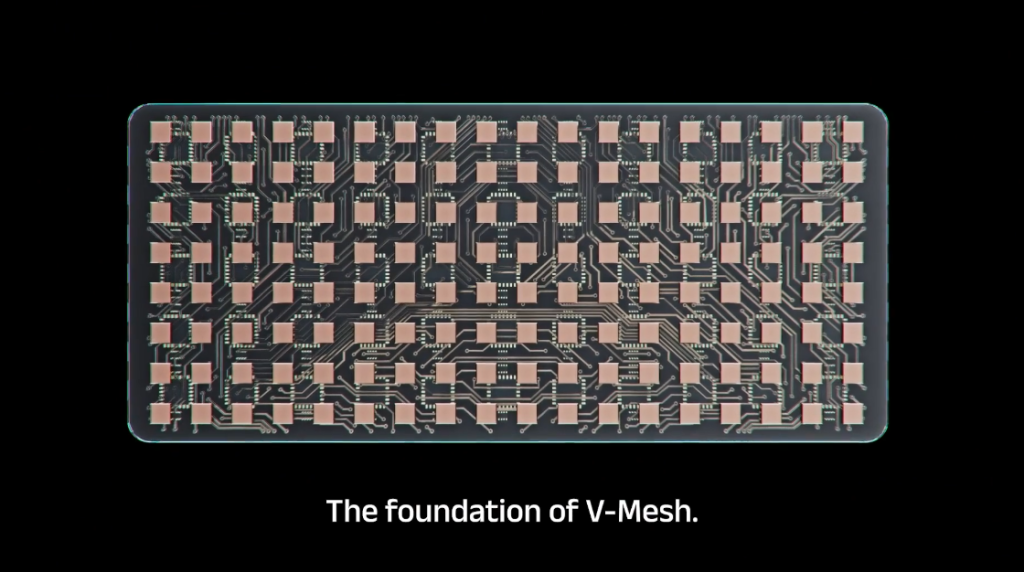
RF-on-Glass™: Built to deploy at scale.
Ubiquitous mmWave coverage requires hardware density that traditional manufacturing cannot sustain.
Glass-scale manufacturing. Visban repeaters are fabricated on glass substrates using the same high-volume processes that power the global display industry — removing the cost constraints of conventional mmWave hardware.
Density without the bottleneck. Low per-unit costs make dense deployment of V-Mesh repeaters viable, so operators can place hardware exactly where coverage is needed — directly on the windows of existing buildings — without economics limiting how far the network can scale.
Become a V-Mesh
Trial Partner
V-Mesh has been validated. Soon, we'll be bringing it into live networks to fine-tune performance and collect real-world data. We're selecting a limited number of trial partners for Q4 2026 — enterprises and private network operators dealing with real mmWave density, NLOS coverage, or in-building continuity challenges.
If that's your environment, fill out the form and we'll be in touch.